
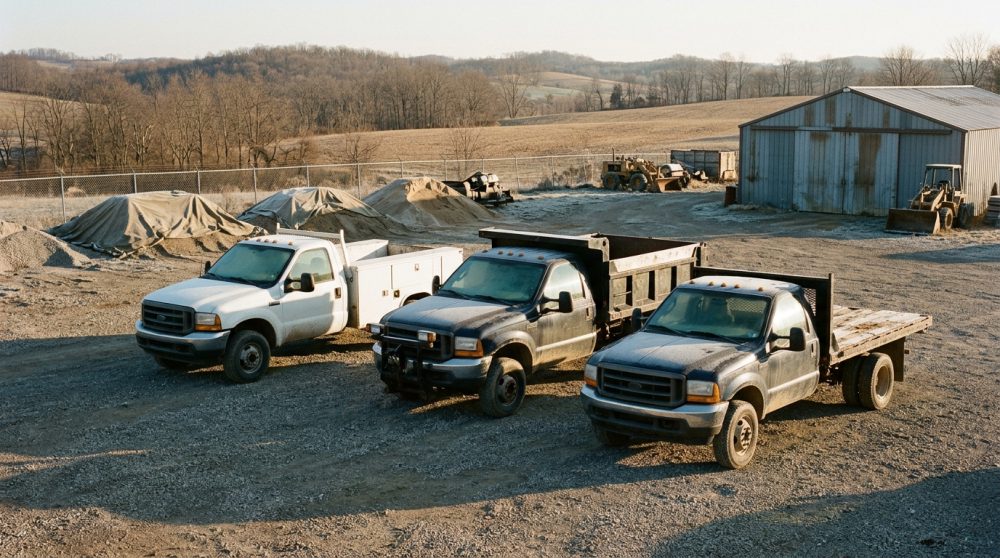
The most practical way to prevent rust on a work truck or small fleet is to treat it as a maintenance job, not a rescue. Protect vehicles while the metal is still sound, pick a rustproofing product that fits how each truck is used, and keep up a regular wash routine through salt season. Rustproofing slows corrosion. It doesn't repair it, and it doesn't make a truck rust-proof forever.
For a business, the real question is usually "which trucks, which product, and when?" The answers come down to age, mileage, how much road salt each vehicle sees, and how long you can spare it from the job.
Why fleets rust differently than a family car
A commuter sedan might see salt on the drive to work. A plow truck, service van, or contractor pickup sees it all day, often while sitting in wet, slushy lots and job sites. Northeast Ohio makes this worse because roads are treated with both rock salt and liquid deicers, and the liquid products cling to a vehicle's underside and into seams.
Work vehicles also take damage that opens the door to corrosion: stone chips, scraped rocker panels, bed liners that trap moisture, and hitches and brackets that rub off coatings. Rust usually starts in those small breaks and in hidden spots like frame rails, body seams, and the insides of doors and rocker panels.
Triage your vehicles first
You don't have to treat everything at once. A simple order of priority keeps the budget and downtime manageable:
- New or nearly new vehicles. These have the most to protect and the cleanest metal to work with. Treating them early is the best value for long-term owners.
- Trucks you plan to keep for years. If a vehicle is staying in the fleet past the point where it's paid off, corrosion is what usually forces it out.
- Vehicles with heavy salt exposure. Plow trucks, road crews, and anything that works outside all winter.
- Older vehicles with surface rust. These can still benefit, but the shop should look at each one first and tell you honestly what it's likely to do.
Matching an NHOU product to the job
Culture Customs is certified for NHOU, and the lineup covers three core rustproofing options plus two specialty products. They aren't interchangeable, so it helps to know what each is for.
- NHOU Premium Oil is the standard premium oil rustproofing option. For most fleet trucks, it's the usual starting point for a conversation.
- NHOU V3 Hybrid Oil is a separate oil-based option. If you're deciding between it and Premium Oil, ask us how the two differ for your specific vehicles rather than assuming they're the same.
- NHOU BOSS WAX is the wax-based option, and it's the product Culture Customs holds NHOU certification for. Wax and oil products behave differently in how they finish and how they're maintained, so this is worth a real conversation if you're choosing for a vehicle that stays in service for a long time.
Details such as the formulation, application method, reapplication needs, and warranty terms belong to each individual product, and they differ. We'd rather walk you through the manufacturer's current documentation than paraphrase it here and risk mixing them up. Any warranty or maintenance requirement should be confirmed in writing before you commit a whole fleet.
Rodent products are a different category
If trucks sit in a yard, barn, or lot overnight, rodents chewing wiring can be a bigger headache than rust. NHOU Mouse Out, including its pouches, is made for rodent deterrence. It isn't an undercoating, and it doesn't protect metal from salt. It also won't guarantee a rodent-free vehicle or stop every instance of damage; it's one layer in an overall approach that includes keeping food, nesting material, and clutter away from parked vehicles.
NHOU Storage Shield is also its own product with its own purpose, aimed at storage-related protection. If you have seasonal equipment or vehicles that sit for months, ask about its documented uses instead of assuming it works like an undercoating.
Why preparation and application matter more with a fleet
When you're protecting several vehicles, consistency is the point. A coating is only as good as the prep underneath it and how thoroughly it reaches the seams, cavities, and lower panels where salt collects. That's where a detailer-led shop earns its keep: we spend time on preparation and coverage because it's what the protection depends on. Ask any installer how they prep, what areas they treat, and how they handle spots like door bottoms and frame ends.
Scheduling around downtime
Plan rustproofing for the quieter parts of your year, ideally before salt season starts. Rotate vehicles through a few at a time so you're never short of trucks. Combine it with other service while a vehicle is in the shop; Culture Customs also does fleet washing, power washing, and detailing, so you can line up protection and routine cleaning with one provider.
Keep up the washing
Rustproofing doesn't replace washing. Rinse salt off vehicles regularly during winter, especially the lower body and underside, and have the coating checked after rough use or visible damage. A truck that gets hit with salt daily and never gets rinsed will fare worse than one on a steady wash schedule.
Frequently asked questions
Does undercoating actually prevent rust?
It can slow it down by putting a protective barrier between metal and moisture, salt, and grime. It doesn't stop rust completely, and results depend on prep, coverage, the product, and upkeep afterward. Be wary of anyone promising a vehicle will never rust.
How much should rustproofing cost?
It varies with vehicle size, the product chosen, and the condition of the vehicle, so there's no honest one-size number. For a fleet, ask for an itemized quote per vehicle that says which product is used and what areas are treated. Culture Customs can provide a quote after looking at what you're driving.
How can I stop salt corrosion on my vehicle?
Combine three things: rinse salt off regularly through winter, repair paint chips and scrapes early, and have a rustproofing product applied before heavy corrosion sets in. No single step does it alone.
Is it possible to fix corrosion on a car?
Existing rust has to be repaired by removing it or replacing the damaged metal. Rustproofing products don't restore lost metal or fix structural corrosion. What they can do is help protect the metal that's still sound.
Talking it through
If you run a few work trucks or a larger fleet in the Strasburg, Dover, New Philadelphia, Canton, or Massillon area, Culture Customs can look at your vehicles and help you decide which NHOU product fits each one. Call 330-331-9572 or stop by 301 S Wooster Ave in Strasburg.
